
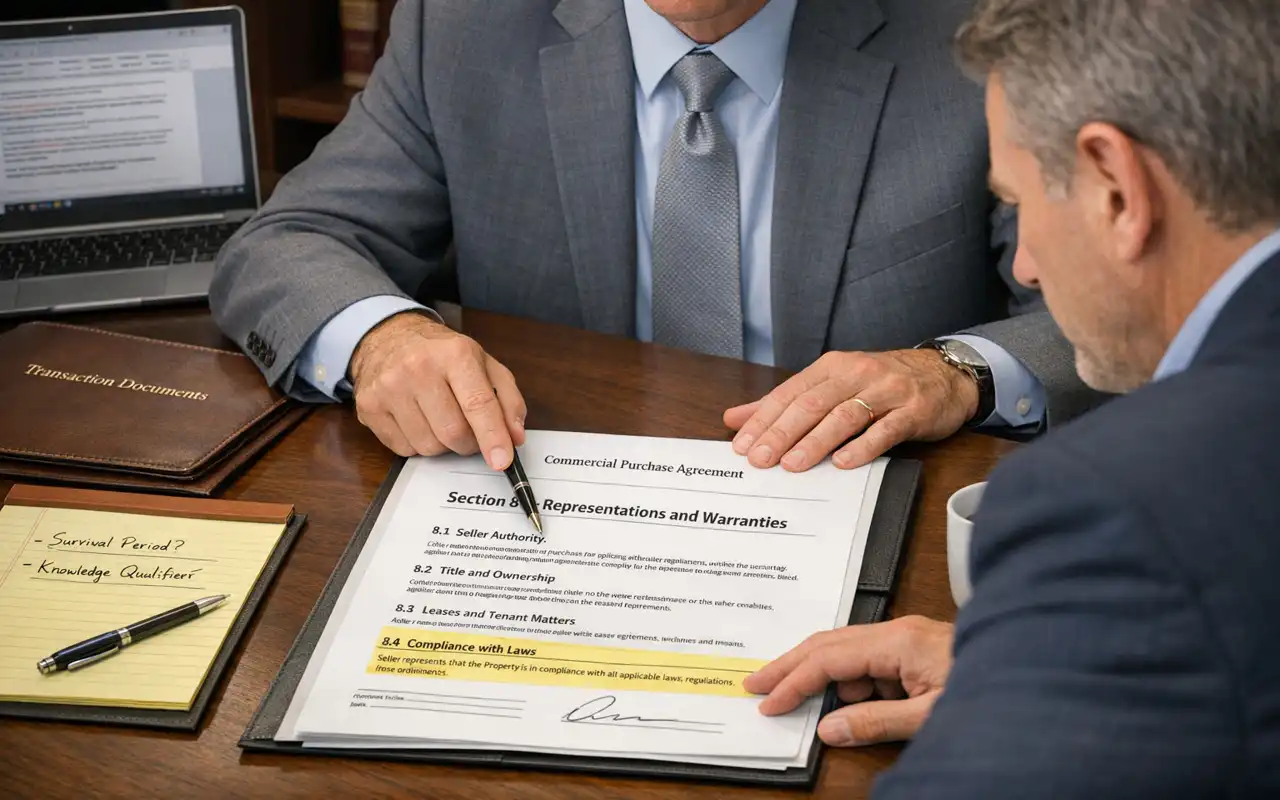
In every commercial purchase agreement, the section on representations and warranties carries substantial legal and financial weight. These provisions define the factual foundation of the transaction. They establish what each party is stating to be true at signing and at closing.
Understanding commercial real estate representations is critical because these clauses determine who bears the risk if something turns out to be inaccurate. If a representation is false, the consequences can include contract termination, delayed closing, escrow holdbacks, indemnification claims, or post-closing litigation. These are not minor contract provisions. They shape the exposure profile of the entire deal.
What Are Representations and Warranties
A representation is a statement of fact about the property, the transaction, or the party making the statement. A warranty reinforces that statement as a promise that it is accurate. In practice, commercial contracts often treat the terms together, but their function is clear. They allocate risk.
For example, when a seller represents that there are no undisclosed leases affecting the property, the buyer is relying on that statement when underwriting rental income. If that statement is incorrect, the buyer may have remedies depending on how the contract is structured.
Similarly, when a buyer represents that it has authority and sufficient funds to close, the seller relies on that statement to remove the property from the market and proceed toward closing.
The more detailed the transaction, the more significant these representations become.
Core Seller Representations in Commercial Transactions
Sellers typically provide a detailed set of commercial real estate representations covering both the property and the ownership structure. Common categories include:
Authority and Capacity
The seller confirms that it has full authority to enter into the contract and convey the property. If the owner is an entity, this includes confirmation that proper corporate or LLC approvals have been obtained. Missing authority can invalidate agreements or delay closing.
Title and Ownership
Sellers often represent that they hold good and marketable title and that no undisclosed liens or encumbrances exist beyond those revealed in the title commitment. This directly ties into due diligence and financing approval.
Lease Representations
In income-producing properties, sellers commonly represent that all leases provided to the buyer are accurate and complete, that tenants are not in default except as disclosed, and that no side agreements exist. These statements protect buyers relying on projected income.
Litigation and Claims
Sellers may represent that there are no pending lawsuits, administrative proceedings, or governmental enforcement actions affecting the property. Undisclosed disputes can materially impact value and lender underwriting.
Compliance With Laws
Some contracts include representations regarding zoning compliance, environmental matters, and building code status. These are often qualified by the seller’s knowledge to limit exposure for unknown conditions.
Each of these categories affects underwriting, pricing, and closing certainty.
Buyer Representations and Transaction Certainty
While seller representations receive more attention, buyers also make important representations. These often include confirmation of:
- Authority to enter into the agreement
- No conflicts with other contractual obligations
- Availability of funds or financing
- Compliance with regulatory requirements
Buyer representations provide comfort to the seller that the transaction will close as agreed. In competitive markets, sellers may scrutinize buyer representations closely to reduce execution risk.
Knowledge Qualifiers and Materiality Standards
One of the most negotiated aspects of commercial real estate representations involves knowledge qualifiers and materiality thresholds.
A seller may limit exposure by stating that a representation is true “to the seller’s knowledge.” This narrows liability to issues the seller actually knows about, rather than unknown conditions. Buyers, in turn, may negotiate for broader representations to increase protection.
Materiality qualifiers are also common. A representation may only apply to matters that are material to the property. This avoids triggering minor technical breaches that do not meaningfully affect value.
These qualifiers are not cosmetic. They define the scope of potential post-closing claims.
Survival Periods and Post-Closing Exposure
Another critical issue is how long representations survive after closing. Some agreements terminate representations at closing. Others allow them to survive for a defined period, often six to eighteen months. Environmental representations may survive longer due to regulatory risk.
Survival periods directly affect liability. If a representation does not survive closing, the buyer’s remedies may be limited once the deed is delivered. If it survives, the buyer may pursue claims within the agreed timeframe.
Negotiating survival periods requires balancing deal certainty with long-term protection.
Indemnification Structure and Liability Caps
If a representation proves false, the injured party may seek indemnification. Commercial contracts typically define:
- Whether indemnification is the exclusive remedy
- Whether liability is capped at a percentage of the purchase price
- Whether a deductible or threshold applies before claims can be made
- Whether certain categories, such as fraud, are excluded from caps
These provisions determine real financial exposure. A poorly structured indemnity clause can leave a party underprotected or overly exposed.
Sophisticated buyers and sellers evaluate indemnity terms carefully because they define the practical consequences of inaccurate representations.
Relationship to Due Diligence
Representations do not replace due diligence. Buyers are still expected to investigate the property during the inspection period. However, representations supplement due diligence by allocating responsibility for information uniquely within the seller’s control.
For example, a buyer may inspect the building physically, but it must rely on seller representations for internal entity approvals or undisclosed litigation. The interaction between due diligence and commercial real estate representations creates the overall risk allocation framework for the transaction.
Why Careful Drafting Matters
In commercial real estate, small drafting changes can significantly alter exposure. Expanding a representation from “no known violations” to “no violations” may dramatically increase seller liability. Shortening a survival period may limit a buyer’s recovery window.
These clauses should reflect the nature of the property, the sophistication of the parties, and the negotiated purchase price. Balanced drafting protects both sides and reduces the likelihood of disputes.
The Role of Legal Counsel
Experienced commercial real estate counsel ensures that representations accurately reflect the property’s condition and the transaction structure. Attorneys evaluate risk allocation, negotiate knowledge qualifiers, define survival periods, and structure indemnity provisions to align with commercial expectations.
Clear drafting reduces ambiguity and protects the enforceability of the agreement. In complex transactions, the representations and warranties section often becomes one of the most heavily negotiated portions of the contract.
Contact Us
At Kleiner Law Group, we assist buyers and sellers in drafting and negotiating commercial purchase agreements that properly allocate risk. Our team ensures that commercial real estate representations are accurate, commercially reasonable, and protective of your long-term interests.
If you are negotiating a commercial real estate contract, call us today at 305-517-1392 for experienced transactional guidance.
